Identiverse 2026: AI Agents Dominate — and Need a Solid Security Foundation
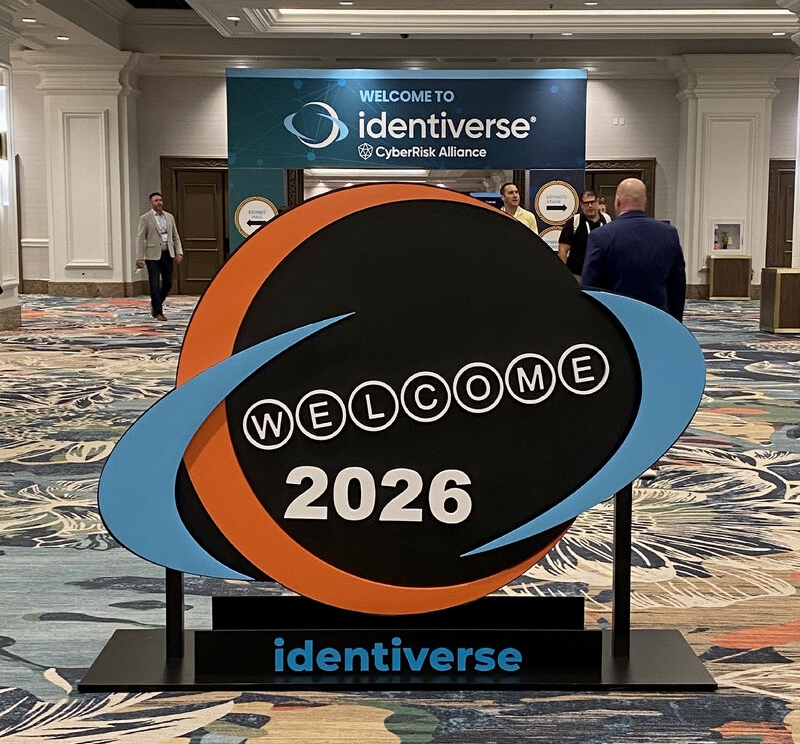
Identiverse 2026: AI Agents Dominate — and Need a Solid Security Foundation
It was that time again: for four days, I headed to Las Vegas for Identiverse 2026. After all, when more than 3,500 experts come together to discuss digital identities and digital trust, our team cannot be missing — to gather inspiration, contribute to discussions, and, above all, identify emerging identity security trends. What did not surprise me: AI was the defining topic.
Focus Topic: AI
A global meeting point for topics around identity management, cybersecurity, privacy, and digital trust — that is Identiverse. It is far more than a series of presentations. It is a platform for networking, best-practice exchange, and fresh impulses from the international identity community. This year, the direction was clear from the start: everything revolved around AI.
A double-edged sword: on the one hand, many attendees were already tired of hearing the acronym after the first day. On the other, the keynotes, workshops, and personal conversations around artificial intelligence were inspiring because one thing quickly became clear: this is not just another trend topic. AI is changing the foundations on which we have built Identity and Access Management (IAM) so far.
AI Agents Are Driving Change
IAM infrastructures were long designed with humans in mind: employees, partners, or customers who receive a digital identity, go through an onboarding process, are assigned roles, use multi-factor authentication, and are regularly reviewed in access reviews. These identities are comparatively stable. They exist for weeks, months, or years. AI agents, however, work differently.
They are created at short notice, take on a specific task, access systems or data, and may disappear again just a few minutes later. Their next steps are not always fully predictable. Which resource they need, which action they perform, and which access is required depends heavily on the specific context.
At this point, traditional IAM models reach their natural limits. Manual onboarding processes are too slow to keep up with this new dynamic. Static role models are too coarse. A fixed rights package no longer works for AI agents that act on a task-specific basis. They need exactly the access that is situationally required for the task at hand. Regular access reviews — monthly, quarterly, or semi-annually — come too late, because identities can be created within seconds, perform an action, and then disappear again. Controls must therefore take effect before and during the action, not only retrospectively.
AI as a Highly Dynamic Contractor
AI is therefore becoming a new actor in identity security. But it should not be treated like a colleague in the traditional sense. Companies should think of AI agents more like external, highly dynamic contractors who are granted only as much trust as is necessary for a specific task. This calls for short-lived identities, fine-grained permissions, context-dependent decisions, transparent logging, and the ability to intervene at any time.
In modern IAM, governance therefore needs to become much more automated. Companies need mechanisms that do not merely manage identities, permissions, and decisions, but can control them in real time. Who is allowed to do what? In which context? For which task? For how long? And how can it later be proven what actually happened?
Back to the Roots: Rethinking IAM Building Blocks
The good news: many of the building blocks already exist. Standards and architectural approaches around OAuth2, federation, external authorization, AuthZEN, FAPI, SPIFFE, and new concepts in the context of AI agents and MCP point the way forward. The challenge is less about reinventing everything from scratch. What matters is bringing existing technologies together in the right way and applying them consistently. From this, several concrete to-dos emerge:
#1 Create Greater Transparency Across Identities Too many cooks spoil the broth — at least when everyone is doing their own thing. The same applies to identities and permissions: without an IAM strategy, the growing number of actors — from employees, partners, and service providers to AI agents, non-human identities, and service accounts — can no longer be controlled. Instead, complexity increases and visibility decreases.
The central question must therefore be: who or what has access to which systems, data, and applications? Individual point solutions are no longer enough to answer this question. What is needed are approaches that consolidate identity information, make risks visible, and derive concrete actions from them.
At Identiverse, the concept of Identity Visibility and Intelligence Platforms, or IVIP, came up more and more frequently. IVIP provides a more integrated view of identities, permissions, and risks across IAM silos. This gives companies greater transparency, which they can use to derive concrete measures: identify overprivileged accounts, prioritize risky access, revoke outdated permissions, and correct deviations in a targeted way.
#2 Do Not Write Off Role Management — Modernize It Some experts have been declaring role models such as RBAC, or Role-Based Access Control, dead for quite some time. The discussions at Identiverse, however, made it clear that they remain essential. Roles help structure permissions in a way that is understandable and transparent for business departments. What matters, however, is developing role management further and adapting it to current requirements. xBAC — the combination of different models — is considered the future:
- RBAC remains relevant as a structuring foundation.
- ABAC, or Attribute-Based Access Control, adds attributes such as location, department, device, risk level, or identity type to access decisions.
- ReBAC, or Relationship-Based Access Control, looks at the relationship between subject and object.
- PBAC, or Policy-Based Access Control, governs access through policies and rules, ideally using all of the above elements.
This makes it possible to overcome previous weaknesses such as roles that are created once, rarely reviewed, or grow uncontrollably over time. Modern IAM solutions should therefore not treat roles in isolation, but analyze, optimize, regularly review, and combine them with attributes, policies, and context-based decisions.
#3 Automate Governance More Strongly One of the less comfortable takeaways from Identiverse: organizations that do not yet have clean API security, a strategy for non-human identities, and dynamic authorization in place will struggle with AI agents. Agentic AI amplifies existing weaknesses in IAM.
Governance must therefore move closer to the actual access decision. Downstream controls are no longer sufficient. Access needs to be controlled more strongly at the moment of decision. Automation can help by identifying risks, evaluating access, making decisions based on defined rules, limiting permissions in time, documenting exceptions, and blocking critical actions or escalating them for approval. This requires a clear policy that defines who is allowed to do what under which conditions.
The goal of automation is not to eliminate human control. Humans define rules, responsibilities, and guardrails. Systems apply these rules consistently, quickly, and traceably. In this way, governance can be operationalized and AI agents can be managed effectively.
Conclusion
There has always been one dominant topic at Identiverse: the evolution of IAM. This year, however, it became clear that AI agents are adding even more speed to that evolution. Companies therefore need to examine their IAM infrastructure and adapt it where necessary. The goal: AI readiness for trusted digital identities — whether human or non-human. And whether we should really still hold on to the concept of “accounts” at all is a question moderator Andi Hindle already raised in Berlin at EIC.
Would you like to modernize your IAM?
Then let us take a look at your current and target state together.